maandag 25 december 2023

Trying out "Shadow of the Eagles" for our FR battle

 We came across new Napoleonic rules by Keith Flint called "Shadow of the Eagles". 

As we use his SYW rules already for our 15mm figures of the WAS period we thought about trying out these for our 28mm French Revolutionary figures and our 15mm napoleonic ones.

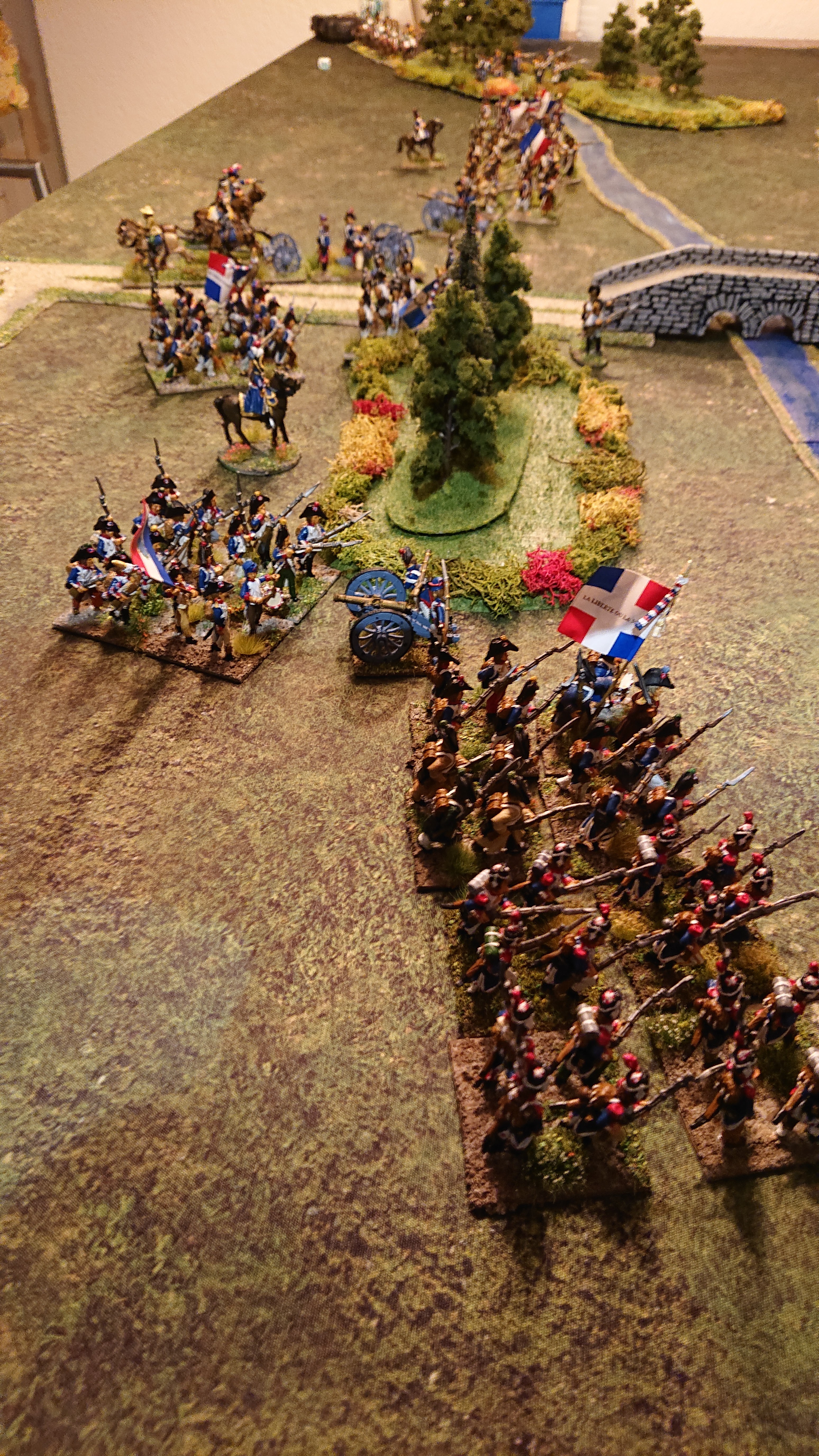
So yesterday evening we cobbled together a small scenario and tried out various events of our miniatures battle.
We must say we like the rules but as these SotE rules are of the simpler kind there will of course rise some questions or there will be situations which are not covered but, to be honest, with our first use we didn't have a lot. 

As our tabletop wasn't big we used the suggested organisation of 16 infantry and 8 cavalry figures and liked that scale so maybe we will rebase (or reduce permanently) our 28mm units to that scale even when using other Napoleonic rules. 
As we were used to different strength units (according to OOB of real battles/campaigns) it was  strange to see the units all of the same strength but this has its advantages. 
What is great imho is, that Keith tries to explain his line of thinking as the background of his rules in the rulebook together with campaign notes from French Revolution up to 1815 plus adds some scenarios.

And when that isn't enough, there is always the possibility to ask questions at his forum. 

We will try the rules some more but as said we like them. Great job done.

Some (telephone) pictures of yesterday's refight.


Historic one Editions French Revolution books

  Historic'one Editions has a serie called "Les Batailles oubliées" in which three French Revolution titles has appeared some time back.


Although in French, imho they are very good and give information about battles of 1793/1794 period.
For those, who like the Napoleon campaign in the east, there are two titles.

Historic'one has also other titles in eg Medieval, Renaissance, Napoleonic and 1870 period; take a look. 

Ca-Ira will be alive again.

Just a short notice that I will add new posts to ca-ira in the coming period. Some how I missed this specific period blog!

I will copy French Revolutionary blog posts which I put on the Alde Garde blog over to this Ca-Ira blog.
Also I will try to put the information of the Dutch army in the French Revolutionary period that was on the now non-functional Alde Garde site on this blog.

And of course, information on books, miniatures etc which are on the blog will be updated.

Hope you enjoy.

And let me know what you miss or which information about the Dutch army of this period you want to see.

And: a great 2024 to all readers!!

zaterdag 27 november 2021

A French Revolution Austrian advance guard

Well, most of the figures were already painted but never on the blog so now, here they are. 

I think you could see them as an advance guard of the Austrian army circa 1793. 

The brigade consists of
- a light infantry component (Tyrolan Jägers and the Slavonisch-Croatisches Freikorps),
- a line infantry component consisting of the 1st and 2nd battalion of the Wenzel Kaunitz Regiment and the grenadier battalion Bardodetzky (combined out of the 2nd, 32nd and 34th line regiments),
- the Karaiczay Cheveau Leger regiment and 
- a battery of field artillery

Figures are mostly by Eureka miniatures; the Freikorps and artillery are by Wargames Foundry.


zaterdag 12 juni 2021

A small Dutch brigade

So at last a small Dutch brigade is ready consisting of  a battalion of the first regiment of Waldeck, two grenadier battalions (Buseck and Larrey) and the hussars of Timmermans. 

The Waldeckers and grenadiers are of the great Emperor Toad range, the hussars from Forgotten Glorious.

The infantry battalions had battalion guns manned by artillery men (so in artillery uniform) and not by commandeered infantry men (as eg in the French army). 

The Dutch figures are by Emperor Toad and are just great. The battalion guns are by Trent and Perry.


zaterdag 5 juni 2021

Information on the Dutch "Hollandse" en "Zwitserse" guard

 Hollandse Garde

Starting with the Hollandse Garde (Dutch Guard) which was in the pay of the province of Holland and its proprietor was the Stadtholder William V of Orange-Nassau. 
The regiment was raised in 1599 as a regiment of Nassau, since 1674 a guard regiment and since 1702 called the regiment Hollandse Garde.

Since the re-organisation of 1752, the regiment had 2 battalions each with 6 musketeer companies and one grenadier company although formally there were just 14 companies of which the first two were grenadiers and the other twelve musketeers. The grenadiercompanies (as in all Dutch infantry regiments) were also referred as Lijfcompagnieën (Life companies)

Regarding its flag; in 1786 the existing flags were under pressure of the then ruling Patriots changed as these didn't like the Orangist heraldic signs which were on the flags.
As with the help of an invading Prussian army the patriots were chased out of Holland in 1787,the Orangists became the ruling class again which resulted in 1788 in new flags (with orangist heraldic signs of course) for the Hollandse Garde.

The patriot-period colonels flag looked like this (from the Rijksmuseum Amsterdam):

This is the backside which shows (unclear I admit) an arm with sword coming out of a small cloud.
The front side shows the same arrangements only the middle oval is the weapon of Holland (red lion on gold background). I don't have a coloured image of that side but will try to get it.  

This 1786 design was changed in 1788 into the colonelsflag underneath of which there are two in the Rijksmuseum so probably both battalions had the same colonelsflag. This is unusual as mostly only the first battalion as fas as we know, had the colonelsflag. 
As the pré 1786 designs are known (in the Rijksmuseum also) both flags must be of the post 1788 period.

The post 1788 flags in the pictures show:
The left one is 98*106 cm of which the background colour is ecru or an offwhite. The backside is the same.
The right one is 117*97 cm with also as background colour ecru. Again, the backside is the same as the frontside.


The regimental colour isn't known but there is a picture of the 1st battalion of the guard of around 1770 (underneath) which shows this older design of the white colonels colour and an orange regimental one.

As the design of the post 1788 regimental flag isn't known, I would suggest for now, the same design for both flags, just different background colour. 
Note the white/silve tassels on the flagpoles. The flagpoles should according to the reglement, painted black.

Regarding the uniforms, Macalister Loup shows the uniform  as underneath


Other pictures of the Hollandse garde are:


An older picture of an officer show the older grenadier bearskin which was worn probably up to around 1770. After that, the bearskin without frontplate was used and this was the example for the rest of the Dutch army (this is mentioned in the reglement of 1772). 
Notice that the bag of the grenadierbeasrkin is red; the same as the colour of the facings.

The drummers wore the following:

I believe that the first two are musicians with the yellow/gold lacing and the drummers with the white/silver lacing are drummers of the musketier companies.


Zwitserse Garde

The Zwitserse garde (Swiss guard) was raised from various Swiss companies in the service of the Dutch State in 1749 although various Swiss regiments were already in the service of the Dutch Republic for a long time.

In the budget of 1792 the regiment is mentioned as consisting of one battalion of 8 strong companies but these would be used as two battalions, each of four companies.
All Swiss regiments had no separate grenadier companies but grenadiers were integral to each company but probably in the field were used as an separate company.
The first company of the regiment was called the lijfcompany or Prinzen Compagnie as the Prince of Orange (The Stadtholder) was its inhaber and owner of the first company.

Each company had its own flag (so in total eight flags were carried but the first company had the white colonelsflag and the 7 other companies had an regimental one.
The colonelsflag on the left one is from the Museum at Zürich; the colonels on the right is from the Dutch Military Museum and is acquired from relatives of the last colonel of the regiment. Probably the white is faded.
Both flags look very similar.

The regimental flag shows the very well known Swiss flames design.(picture also from the Zurich museum)
 

While the Hollandse garde had white/silver tassels on the flag, the swiss flag above shows an orange cravat. In fact all Swiss flags shows the orange cravat.

Some uniforms of the Swiss guard:


Notice that the bag of the Swiss grenadier bearskins were blue although the facing colour was red.  


Probably again musicians (with yellow lacing) of the Swiss guard.
woensdag 5 mei 2021

Completed Armee du Nord infantry brigade

At last a completed (well, one battalion gun is still missing) infantry brigade of the Armee du Nord 1793-1795 consisting of two demi brigades each of one line and two volunteer battalions, a small combined grenadier battalion and an artillery battery (8 pdr).


Most of the figures are Eureka, with a sprinkling of some other firms. 

Each battalion will be of 6 bases of which one is a battalion gun (the regulars are missing one base of infantry and the battalion guns should imho be manned by white coated artillerymen from the battalion itself). Also one volunteer battalion misses its battalion gun. All missing parts are being in the painting que. 
The artillery battery consists of two guns, a dismounted artillery officer, a limber and ammunition caisson. It needs some room when deployed.