Posts tonen met het label FR Armies - Dutch. Alle posts tonen

donderdag 28 december 2023

My first 28mm Dutch heavy cavalry: the Karabiniers Oranje-Friesland

  I have finished the first Dutch heavy cavalry regiment. It is a special unit as it consisted in fact of two smaller regiments

Normally the Dutch cavalry (heavy cavalry and dragoons) consisted of 4 squadrons but the Karabiniers Oranje-Friesland consisted of two two squadron strong regiments: 

the Orange Carabiniers van zijne Hoogheid (payed by the province of Holland) and
Orange-Vriesland (payed by the province of Friesland)

By the way, the above mentioned names come from the officer register of 1790 (Naamregister der Heeren militaire officieren....)

The uniform was according to the "Jassenboekje" white with blue facings but with gold buttons for the Orange-Vriesland and silver for the Orange Carabiniers. There were also other, smaller, differences in the dress of both regiments.

But unlike the "Jassenboekje" the plates by Coopmans (see underneath) and also by Duncan Macalester Loup show the Orange-Vriesland in a darker blue (gold buttons) and the Orange Carabiniers in a lighter blue (with silver buttons).


So I painted my regiments in two different colours.

As it was a heavy cavalry regiment it of course should have a flag but no flags of Dutch cavalry are known; only one plate show a vague orange coloured cavalry flag.

So onto the drawing board and I used as backgroundcolour Orange with on one side the heraldic sign of Stadtholder William V (which was the owner for both regiments) and on the other side the well known armoured arm with sword coming out of a cloud (used by a lot for Dutch regiments in te past).

As I don't know how to make these on the computer itself, I copied the two pictures and handpainted the flag.
So underneath some pictures of the regiment (or better two regiments). Sadly my standard bearer was glued not totally straight on the horse and I was afraid that I would damage the figure when I would correct that.

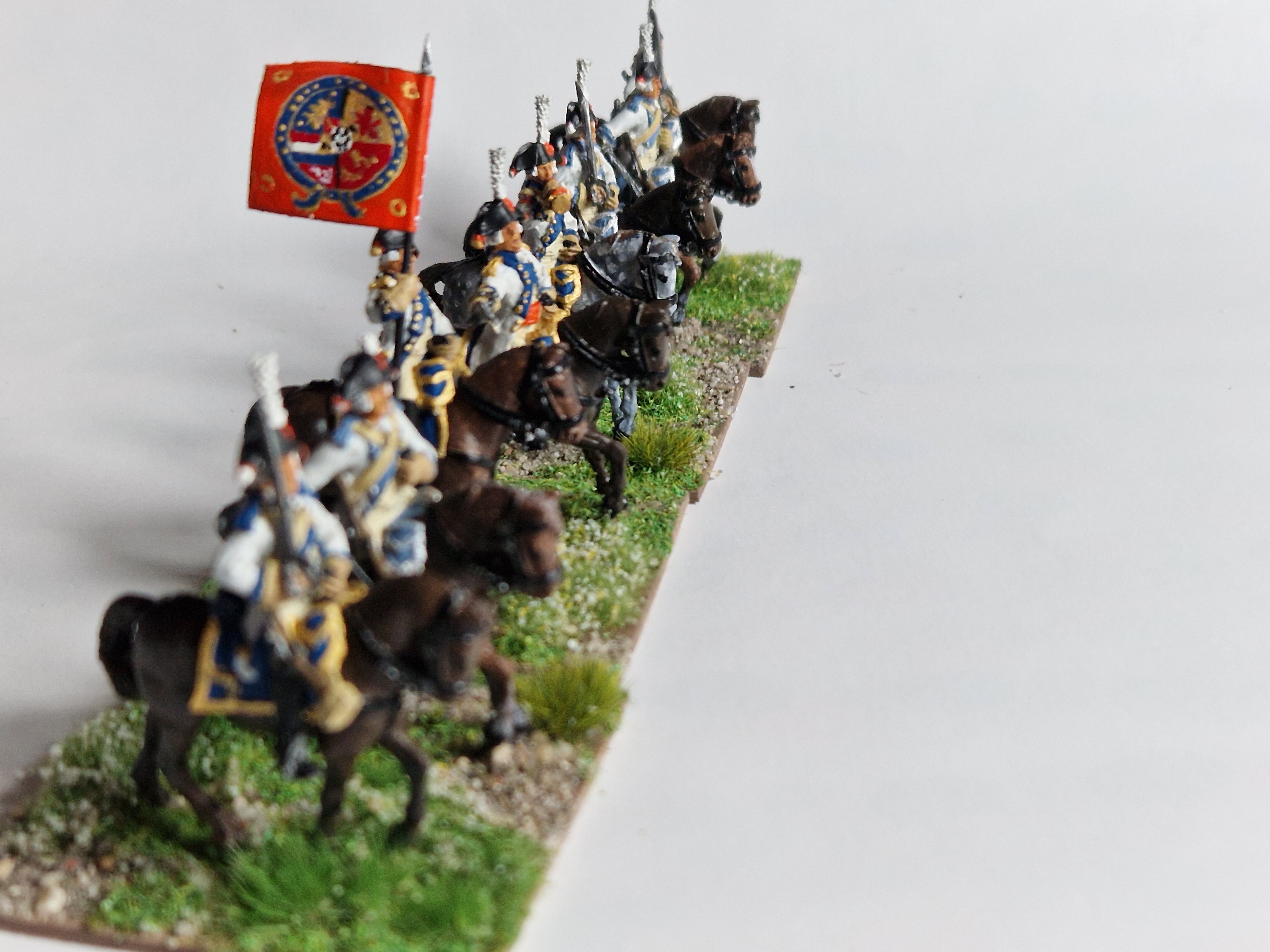

The miniatures are of course by Emperor Toad but now sold by Skytrex.

On this moment the unit consists of 8 figures but as I am going to a standard unit strength of 12 figures for a cavalry unit; the last four are on the painting desk. 

As in fact the unit are made of two regiments it will receive two flags. As the  already painted Orange flag would be more suited the Orange-Vriesland regiment, the other flag will be white with on one side the heraldic sign of Stadtholder William V and on the other side the provincial ornaments of the Province of Holland (paymaster of the regiment).


zaterdag 12 juni 2021

A small Dutch brigade

So at last a small Dutch brigade is ready consisting of  a battalion of the first regiment of Waldeck, two grenadier battalions (Buseck and Larrey) and the hussars of Timmermans. 

The Waldeckers and grenadiers are of the great Emperor Toad range, the hussars from Forgotten Glorious.

The infantry battalions had battalion guns manned by artillery men (so in artillery uniform) and not by commandeered infantry men (as eg in the French army). 

The Dutch figures are by Emperor Toad and are just great. The battalion guns are by Trent and Perry.


zaterdag 5 juni 2021

Information on the Dutch "Hollandse" en "Zwitserse" guard

 Hollandse Garde

Starting with the Hollandse Garde (Dutch Guard) which was in the pay of the province of Holland and its proprietor was the Stadtholder William V of Orange-Nassau. 
The regiment was raised in 1599 as a regiment of Nassau, since 1674 a guard regiment and since 1702 called the regiment Hollandse Garde.

Since the re-organisation of 1752, the regiment had 2 battalions each with 6 musketeer companies and one grenadier company although formally there were just 14 companies of which the first two were grenadiers and the other twelve musketeers. The grenadiercompanies (as in all Dutch infantry regiments) were also referred as Lijfcompagnieën (Life companies)

Regarding its flag; in 1786 the existing flags were under pressure of the then ruling Patriots changed as these didn't like the Orangist heraldic signs which were on the flags.
As with the help of an invading Prussian army the patriots were chased out of Holland in 1787,the Orangists became the ruling class again which resulted in 1788 in new flags (with orangist heraldic signs of course) for the Hollandse Garde.

The patriot-period colonels flag looked like this (from the Rijksmuseum Amsterdam):

This is the backside which shows (unclear I admit) an arm with sword coming out of a small cloud.
The front side shows the same arrangements only the middle oval is the weapon of Holland (red lion on gold background). I don't have a coloured image of that side but will try to get it.  

This 1786 design was changed in 1788 into the colonelsflag underneath of which there are two in the Rijksmuseum so probably both battalions had the same colonelsflag. This is unusual as mostly only the first battalion as fas as we know, had the colonelsflag. 
As the pré 1786 designs are known (in the Rijksmuseum also) both flags must be of the post 1788 period.

The post 1788 flags in the pictures show:
The left one is 98*106 cm of which the background colour is ecru or an offwhite. The backside is the same.
The right one is 117*97 cm with also as background colour ecru. Again, the backside is the same as the frontside.


The regimental colour isn't known but there is a picture of the 1st battalion of the guard of around 1770 (underneath) which shows this older design of the white colonels colour and an orange regimental one.

As the design of the post 1788 regimental flag isn't known, I would suggest for now, the same design for both flags, just different background colour. 
Note the white/silve tassels on the flagpoles. The flagpoles should according to the reglement, painted black.

Regarding the uniforms, Macalister Loup shows the uniform  as underneath


Other pictures of the Hollandse garde are:


An older picture of an officer show the older grenadier bearskin which was worn probably up to around 1770. After that, the bearskin without frontplate was used and this was the example for the rest of the Dutch army (this is mentioned in the reglement of 1772). 
Notice that the bag of the grenadierbeasrkin is red; the same as the colour of the facings.

The drummers wore the following:

I believe that the first two are musicians with the yellow/gold lacing and the drummers with the white/silver lacing are drummers of the musketier companies.


Zwitserse Garde

The Zwitserse garde (Swiss guard) was raised from various Swiss companies in the service of the Dutch State in 1749 although various Swiss regiments were already in the service of the Dutch Republic for a long time.

In the budget of 1792 the regiment is mentioned as consisting of one battalion of 8 strong companies but these would be used as two battalions, each of four companies.
All Swiss regiments had no separate grenadier companies but grenadiers were integral to each company but probably in the field were used as an separate company.
The first company of the regiment was called the lijfcompany or Prinzen Compagnie as the Prince of Orange (The Stadtholder) was its inhaber and owner of the first company.

Each company had its own flag (so in total eight flags were carried but the first company had the white colonelsflag and the 7 other companies had an regimental one.
The colonelsflag on the left one is from the Museum at Zürich; the colonels on the right is from the Dutch Military Museum and is acquired from relatives of the last colonel of the regiment. Probably the white is faded.
Both flags look very similar.

The regimental flag shows the very well known Swiss flames design.(picture also from the Zurich museum)
 

While the Hollandse garde had white/silver tassels on the flag, the swiss flag above shows an orange cravat. In fact all Swiss flags shows the orange cravat.

Some uniforms of the Swiss guard:


Notice that the bag of the Swiss grenadier bearskins were blue although the facing colour was red.  


Probably again musicians (with yellow lacing) of the Swiss guard.

zaterdag 6 februari 2021

photos of Dutch Hussars and rebased Löwenstein-Wertheim jagers

Underneath a photo of a small unit (2 squadrons) of the Dutch hussar unit Huzaren Van der Hoop (1787-1794) which was renamed for the rest of the Revolutionary period as Huzaren van Timmermans.

These are Forgotten Glorius miniatures in 28mm. Sadly the firm is no longer with us.


The next pictures are from the 28mm Löwenstein-Wertheim jager unit which was hired by the Dutch States in 1794 until disbandment in 1795. As the Dutch were short of light troops they hired this unit.

Description shows them in helmet and in an early corsehut but I like the helmet as it shows their Bavarian origin and as their uniform resembles the early Würtemberg unifom very much I use Würtemberg miniatures.

I have these miniatures already shown, but they are now rebased.


 I also took some new pictures of my grenadiers


Let me know which you find the better pics


maandag 1 februari 2021

2 Grenadier battalions of 1793 in 28mm

 Although not the quickest and certainly not the best painter underneath my first two Dutch (grenadier) battalions in 28mm. 

Made by Emperor Toads and I like them very much

Starting with the grenadier battalion of Van Buseck with from left to right (and second picture of course from right to left) the companies of the regiments Van Brakel (nr 10), Van Dopf (nr 3), Quadt (nr 13) and the Nassau-Usingen (wallon regiment)


The second grenadier battalion is the battalion of De Larrey with from left to right (and second picture of course from right to left) the companies of the regiments Erfprins (regiment Oranje-Nassau 3), Oranje-Nassau nr 1, Oranje-Nassau nr 2 en Markgraaf van Baden (afaik the only regiment with grey trousers - according to the Jassenboekje).


woensdag 4 november 2020

Grenadier bearskins of the Dutch army 1790-1795

The grenadiers of the Dutch army in the French Revolution all did wear the bearskin.
In the mid 18th century both the Prussian style metal-fronted mitre and the bearskin was worn by the grenadiers but the mitres were faded out and only the bearskin as headdress remained.

Up to 1770 a lot of regiments had a plate fronted bearskin as the Hollandse Garde did wear in the picture on the underneath (picture Rijksmuseum from circa 1770).

Some other pictures of this front-plated bearskin underneath.


regiment nr 14 Nassau Usingen (1756-1775), facing purple and bag blue

But in the reglement of 1772 is stated, that line regiments need to wear the bearskin without frontplate and this bearskin should be modelled according to the bearskin of the Hollandse Garde.
Regiments who did wear the plate fronted bearskin had to adept their bearskin (eg remove the plate). This would have taken some years but in the French Revolutionary period this proces would be  finished and all regiment woud wear the same bearskin.

This would be like the pictures underneath:

Zwitserse Garde (fcings red-blue bag)


 Zwitserse Garde (facings red-blue bag)-timmerman 


Hollandse Garde (facings red-red bag) 


Hollandse Garde drummer (facingsfacings red- red-red bag)


Hollandse Garde officers (facings red-red bag)


Regiment Erfprins (facings orange-orange bag)


regiment Orange Nassau I or II on the left (facing and bag-red) and Garde Groningen on the right (facings and bag red) 
regiment Erfprins (facinga and bag orange) on the left and regiment Nassau Usingen (or regiment Walen) on the right (facings white but blue bag)
regiment Westerloo reg nr 21 (mariniers) with yellow bag and yellow facings

regiment 24 Dundas (1784) with red bag although facings are a light blue.
In 1789 this became regiment nr 24 Bentinck with same facing colours.


period: 1789. 
The two soldiers on the left are Hollandse garde (see above), the third is Regiment nr 12 van Bylandt (in 1789 nr 12 Bedaulx with same facings) with red facings and blue bag.
On the right the 5th battalion of Waldeck.


The two soldiers on the left are Zwitserse garde (see above) with red facings and blue bag.
The two soldiers on the right are Reg Zwitsers nr 5 May with red facings and red bag


Conclusion: Colouring of the bag

Regarding the colouring of the bag, it seems, that in the majority of the regiments, the bag colour was the same as the facings (ie red facings-red bag) but there are some exceptions although I don't have all the pictures so I am not totally sure.

What I found:

Zwitserse Garde: facing red - bag blue
reg 12 Bijlandt (Bedaulx); facing red - bag blue
reg 24 Dundas (Bentinck): facing blue - bag red
reg Nassau-Usingen (or reg Walen): facing white - bag blue


Bearskins of cavalry

Various plates of the first company (lijf compagnie) of the first squadron of the Garde Dragonders (Guard Dragoons) show them wearing bearskins. 

It is hinted, that maybe the first company of the other dragoon regiments (Bijlandt and Hessen-Kassel) also had the bearskin but there is no pictural evidence.

So underneath only the Garde Dragonders:


 It is strange that the officer in the first and the troopers in the 3rd and 4th picture have a red bag and the trooper on the 2nd pictue (right) a blue bag. Probably a mistake


Powdered hair

I don't know if you noticed but all drawings/prints of the Dutch army from this period show powdered hair. 
And it didn't end in 1795 but even in the Batavian Republic period  the Dutch/Batavian army personel powdered their hair. 
Also, it is known that King Louis reminded soldiers to powder their hair but in drawing of the years after 1807 hair is shown in it natural colour and not powdered anymore.